By Jannes Vercaemst
In an age when comfort is often taken for granted, occasionally seeking to experience discomfort can make an important contribution to physical and mental development. In this respect, one of the most powerful tools that I regularly apply and would recommend at all The Green Athlete customers is cold therapy. This involves ice baths, cold showers and other forms of exposure to coldness. Why do I recommend it? Not because it is comfortable (usually it isn’t), but because it works.

Greater motivation and focus, thanks to dopamine
Cold therapy increases the level of dopamine, the substance in your brain that regulates your motivation, reward and focus. Whereas your dopamine level falls after quick-fix ‘kicks’ like social media or junk food (following which you often feel sluggish), an ice bath results in a slow and sustainable dopamine increase, up to two and a half times your normal level. What’s more, this effect can last for 4 to 5 hours.
For me, this makes cold therapy one of the most powerful tools to start the day full of positive motivation. For athletes or busy people it is a great way to experience improved drive and mental clarity.
Train your stress response: mental resilience through hormesis
Cold therapy is a form of hormesis, a biological principle by which the body becomes stronger as a result of exposure to small and controlled stress stimuli. Think, for example, of the way your muscles become stronger after sustained physical activity or how your immune system becomes more effective after short periods of cold or fasting. The important thing is not to avoid stress, but rather to learn how to apply it in the right dosage.
Exposure to cold conditions activates a number of defence mechanisms in the body: your blood vessels constrict, additional stress hormones are released and your metabolism speeds up. But because the cold stimuli are temporary and controlled, your body recovers quickly and becomes stronger.
What I find especially interesting is the fact that this process also has a mental effect. You learn in the most literal way that stress is not something that you should per se avoid, but is actually something that your body can cope with and even use to make itself better than before.
The crucial role of timing and dealing effectively with inflammation
Ice inhibits inflammations. That sounds positive, but there is an important nuance that you must always bear in mind. After power training, your body needs to experience a natural inflammatory reaction in order to recover and become stronger. If you take an ice bath immediately following such a power training session, you can actually hinder the recovery process. In other words, timing is everything.
I most frequently take an ice bath in the morning, as a kickstart to my day, or else at moments when I need extra focus and calm; for example, just before giving a keynote address. By taking an ice bath or cold shower, you activate (amongst other things) your sympathetic nervous system and the body’s heat production processes. This supports natural warming and alertness in the morning, gives a boost to your biorhythm and can even help you to reset following jetlag.

Fat combustion and metabolism: active brown fat
Cold conditions activate brown fat, a type of fat tissue that burns energy to produce heat. This stimulates your metabolism, increases fat combustion and can help to counteract insulin sensitivity, which is particularly interesting for people who are working to reduce their level of fat or improve their metabolic health. After an ice bath, I recommend (and this is supported by science) that you should not immediately seek to warm up by taking a hot shower or sauna. Instead, let your body warm itself up in its own time. This natural process strengthens the metabolic benefits.
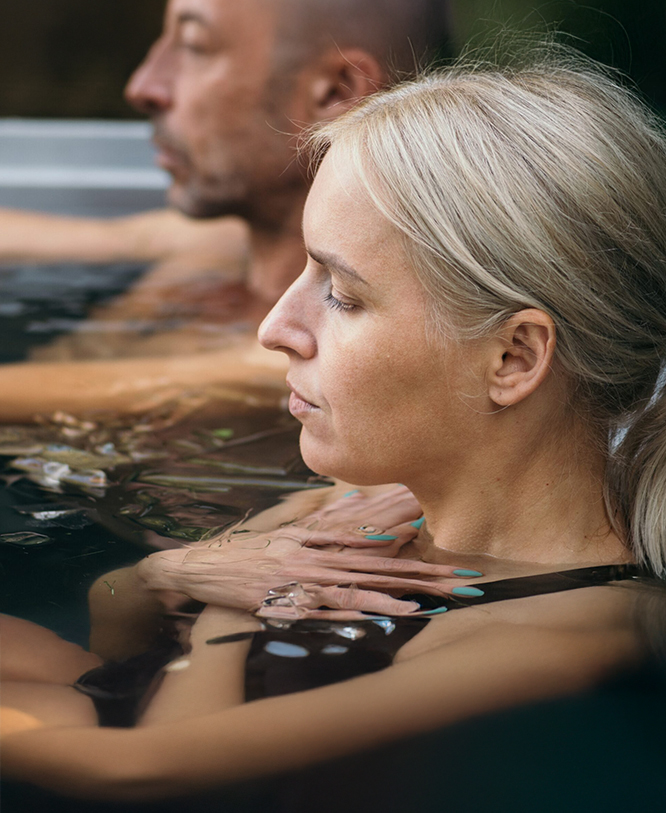
Immune system and recovery
Regular exposure to the cold increases the production of white blood cells, which strengthens the immune system. In addition, it also helps to reduce chronic inflammations and accelerates recovery. Especially if you train frequently, cold therapy is a simple but effective way to optimise your recovery, providing you use it at the right moment.
Training willpower: the power of discomfort
Willpower is not a fixed given. It is trainable. According to neuroscientist Andrew Huberman, you can quite literally make your brain stronger by regularly and voluntarily subjecting yourself to some form of discomfort. This might be a cold bath, a heavy training session or a period of fasting. You don’t do it because it is fun; you do it because it works.
When you consciously do something difficult, your brain learns to deal with the resulting stress but without panicking. You effectively increase your ‘mental elasticity’. Huberman explains that in this way your nervous system also becomes more capable of dealing with other kinds of pressure. After an ice bath, completing a difficult task somehow doesn’t seem quite so difficult. This is not because the task has become any easier. It is you who has become stronger.
You can also train your dopamine system. In this way, you learn to derive satisfaction from doing difficult things, but without any direct form of reward. This increases your focus, discipline and tenacity at the moments when you need them most.
In short, discomfort is not an enemy, but a teacher. By regularly seeking out discomfort you build up real resilience – both mental and physical.
My golden rules for cold therapy
- 2–5 times each week is ideal.
- Temperature: Cold enough to be uncomfortable, but always safe.
- Duration: Listen to your body and follow your gut feeling: chattering teeth is one sign of good cold stimulation.
- Timing: In the morning, to kickstart your day. Avoid ice baths immediately after power training.
- Breathing: Focus on breathing out slowly and calmly.
Finally…
Whether you are a fanatical sportsman or woman, or simply someone who wants to take a more conscious approach to your health, cold therapy is a powerful tool to help you become a better version of yourself. What’s more, it is freely available to everyone! It only requires a small effort on your part, but what you get in return is well worth it: better focus, motivation, mental resilience and physical recovery.